
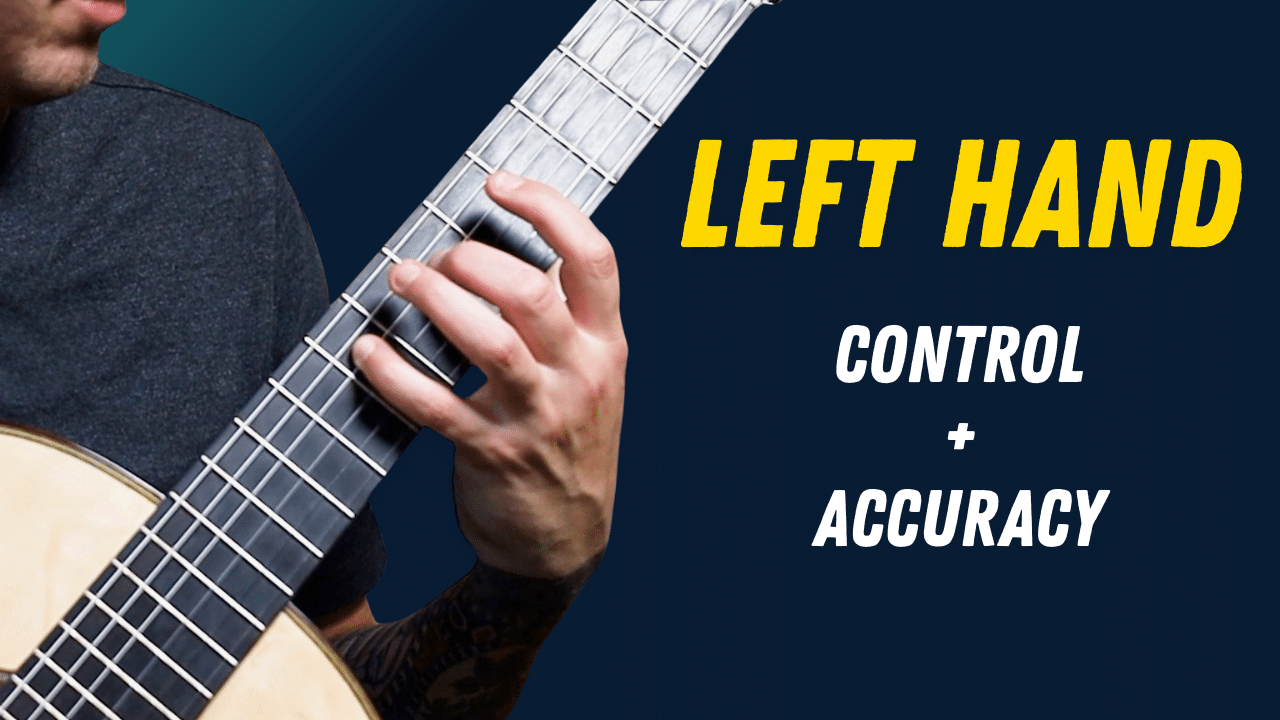
If you want cleaner fretting, faster chord transitions, and confident shifts up the neck, start with the Spider Exercise for guitar—also called The Crawl. This focused drill trains finger independence, stretch, and precision in minutes a day.
It’s a staple I give to absolute beginners and early-intermediate students alike inside my Guitar Foundations course.
Jump to Section:
- What is the Spider Exercise?
- Setup: Hand Position
- The Basic Spider Walk Exercise (Step-by-Step)
- Finger Leadership Variations
- Advanced Spider Crawl Exercise (Finger Pairs)
- One-Week Practice Plan
- Common Mistakes (and Quick Fixes)
- How difficult is it to learn the spider walk on guitar?
- FAQ: Spider Exercise Guitar
What is the Spider Exercise (aka “The Crawl”)?
The guitar spider exercise is a left-hand coordination drill where your fingers “walk” across strings and frets like a spider.
It’s simple to understand, but powerful for building:
- Finger independence – each finger moves on its own without dragging others along.
- Accuracy & control – precise landings = cleaner notes and smoother transitions.
- Stretch & dexterity – gentle, repeatable range-of-motion work.
- Balanced hand position – sets you up for everything from basic chords to intricate lines.
Setup: Hand Position & Fretboard Map (5th Position)
Start relaxed in 5th position string 1 (high E):

- Finger 1 (index) → fret 5
- Finger 2 (middle) → fret 6
- Finger 3 (ring) → fret 7
- Finger 4 (pinky) → fret 8
Keep the thumb light behind the neck, wrist neutral (avoid collapsing), and fingers curved. Aim to place each fingertip just behind the fret for a clear tone with minimal pressure.
The Basic Spider Walk Exercise (Step-by-Step)
- Plant all four fingers on string 1 (E): 5–6–7–8.
- Lift Finger 1 and place it on string 2 (same fret).
- Move Fingers 2–3–4 together up one string (to string 2), staying relaxed.
- Repeat the pattern across the strings: Finger 1 moves alone; 2–3–4 follow together.
- Reverse to descend.
Stay relaxed. If your forearm or thumb squeezes, lighten up. You only need enough pressure for a clean note.
Pro Tip: The “Springboard” Secret
Think of each planted finger as a springboard—it stabilizes the hand so the moving finger can travel accurately.
Don’t hover all fingers at once. Instead, anchor what you can, move only what you must. This quiets unnecessary motion and skyrockets precision.
Finger Leadership Variations
After the basic crawl, rotate which finger “leads”:
- Finger 2 leads → then 1–3–4 follow the pattern.
- Finger 3 leads (often the trickiest—be patient).
- Finger 4 leads (great pinky strengthener).
These variations are the heart of spider practice guitar work—they expose weak links and make them strong.
Finger 3 is the real problem child on guitar—not your pinky!
It’s tempting to blame the left hand pinky for being slow and weak. However, the ring finger is arguably weaker, slower, and less agile.
Watch how awkward finger 3 gets during the Spider Exercise (slow-motion + real-time proof).
Advanced Spider Crawl Exercise (Finger Pairs)
Level up coordination by moving pairs:
- 1 & 3 together, then 2 & 4 together, alternating across/through the strings.
- Keep fingertips close to the strings; minimize lifts.
- Go slow enough to stay totally relaxed and accurate.
This advanced spider exercises for guitar progression adds brain-hand challenge that pays off in real music.
One-Week Practice Plan (Fast Results in Short Bursts)
Schedule: 3 micro-sessions per day (2–5 minutes each). Do them while warming up or even silently while watching TV.
- Day 1–2: Basic crawl in 5th position (ascend/descend).
- Day 3–4: Add Finger 2 leads; keep the “springboard” feel.
- Day 5: Add Finger 3 leads (slowest day; stay patient).
- Day 6: Add Finger 4 leads.
- Day 7: Try 1&3 / 2&4 finger-pair version.
Tempo tip: Start where you can play perfectly (even 40–60 BPM with one click per move). Increase only after a flawless pass.
Common Mistakes (and Quick Fixes)
Here’s some common mistakes to avoid when doing the Spider exercise:
- Pressing too hard → Aim for minimum pressure. If a note rings, you’re pressing enough.
- Flying fingers → Keep inactive fingers close to the strings. Think “compact, quiet hands.”
- Collapsed knuckles → Re-curve fingertips and support with a gentle thumb.
- Neck too flat or too high → Slight upward neck angle helps ergonomics and accuracy.
- Speeding up before ready → Perfect first, then faster.
How difficult is it to learn the spider walk on guitar?
Not very—to learn. It’s a straightforward pattern most players grasp in a few minutes.
What takes time is mastery: staying relaxed, keeping fingers independent, and landing with millimeter-level accuracy. With the 1-week plan above (3 short reps/day), students typically notice:
- Cleaner chord changes
- Stronger ring and pinky control
- Less left-hand tension
- More reliable shifts and stretches
I promote consistency is better than intensity. Small, perfect reps beat long, sloppy practice every time.
FAQ: Spider Exercise Guitar (Quick Answers)
What is the spider walk exercise?
A left-hand coordination drill where one finger moves at a time (or in pairs) while others stay relaxed and close to the strings.
Where should I start it?
5th position (frets 5–8) is comfortable for most hands. Later, explore higher and lower positions.
How often should I practice it?
Short bursts 3×/day work wonders. Keep it relaxed and precise.
Classical only, or all styles?
All styles. The control you build helps chord changes, solos, barre endurance—everything.
When do I add the advanced version?
Once the basic crawl feels smooth and tension-free at a moderate tempo.
Related Lessons & Next Steps
Viral Spider Exercise Short (quick demo)
Struggling with finger independence or coordination? This quick Spider Exercise will level up your technique—no matter your skill level!