

Let’s dive into one of the most essential skills for classical guitarists: how to read sheet music, also know as music notation. Although this is a huge topic, the goal here is to break things down simply by focusing on five core areas that will make sheet music reading a lot more manageable.
Whether you’re completely new or just looking for a refresher, we’ll cover everything you need to get started with reading guitar music fluently.
Plus, you can download a free guitar sheet music guide here.
In This Article:
- The Music Staff
- Key Signatures and Time Signatures
- Note Values
- Guitar Notation Symbols
- Dynamics and Accents
FREE Guide PDF Download
- How to Read Guitar Sheet Music Guide
- Free Guitar Sheet Music Finder (by Composer)

The Music Staff
The musical staff consists of five lines and four spaces, with notes written both above and below the staff.
Clefs
Guitarists are lucky – we only use the treble clef:
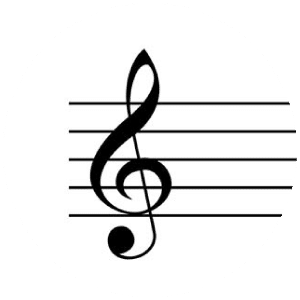
Unlike pianists, who juggle both treble and bass clefs, we stick to just one. However, you’ll often play notes that are above or below the staff.
Acronyms for Reading Notes
The music staff is made up of lines and spaces. Although notes can be above or below the staff lines, a good strategy is to memorize the lines and spaces first.
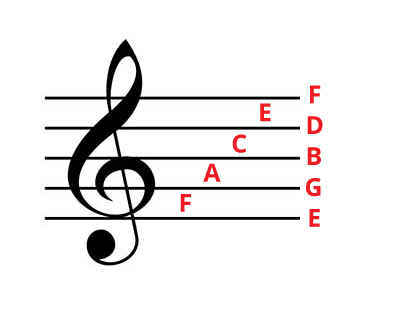
Here are the most common acronyms for memorizing the lines and spaces of the music staff:
- Lines: Every Good Boy Does Fine (E-G-B-D-F)
- Spaces: FACE (F-A-C-E)
I recommend you memorize “space is FACE” first. That’s more memorable because it rhymes, and from there you can easily find the notes that go on the lines above or below those spaces.
Free Resources for Learning Note Names
Here’s some additional free resources to help you recognize notes faster:
- Note Name Identification
- A flashcard quiz that helps you learn the notes on the treble clef that we see most often as guitarists from Low E (Open String 6) to High E (String 1, Fret 12)
- Note Name Identification (Advanced)
- In this flashcard quiz, you’ll need to place the note on the staff for the given note name. The quiz does’t care which octave you choose, only that the note value and accidental is correct.
- Head’s up: The quiz defaults to having the natural symbol highlighted, however if they ask for a simple note name – like “G” – then you actually need to select the “None” button” to get a correct answer.
- In this flashcard quiz, you’ll need to place the note on the staff for the given note name. The quiz does’t care which octave you choose, only that the note value and accidental is correct.
- Video Lesson: Find Any Note on the Guitar Fretboard Fast – Half Steps vs Whole Steps
Key Signatures and Time Signatures
Key Signatures
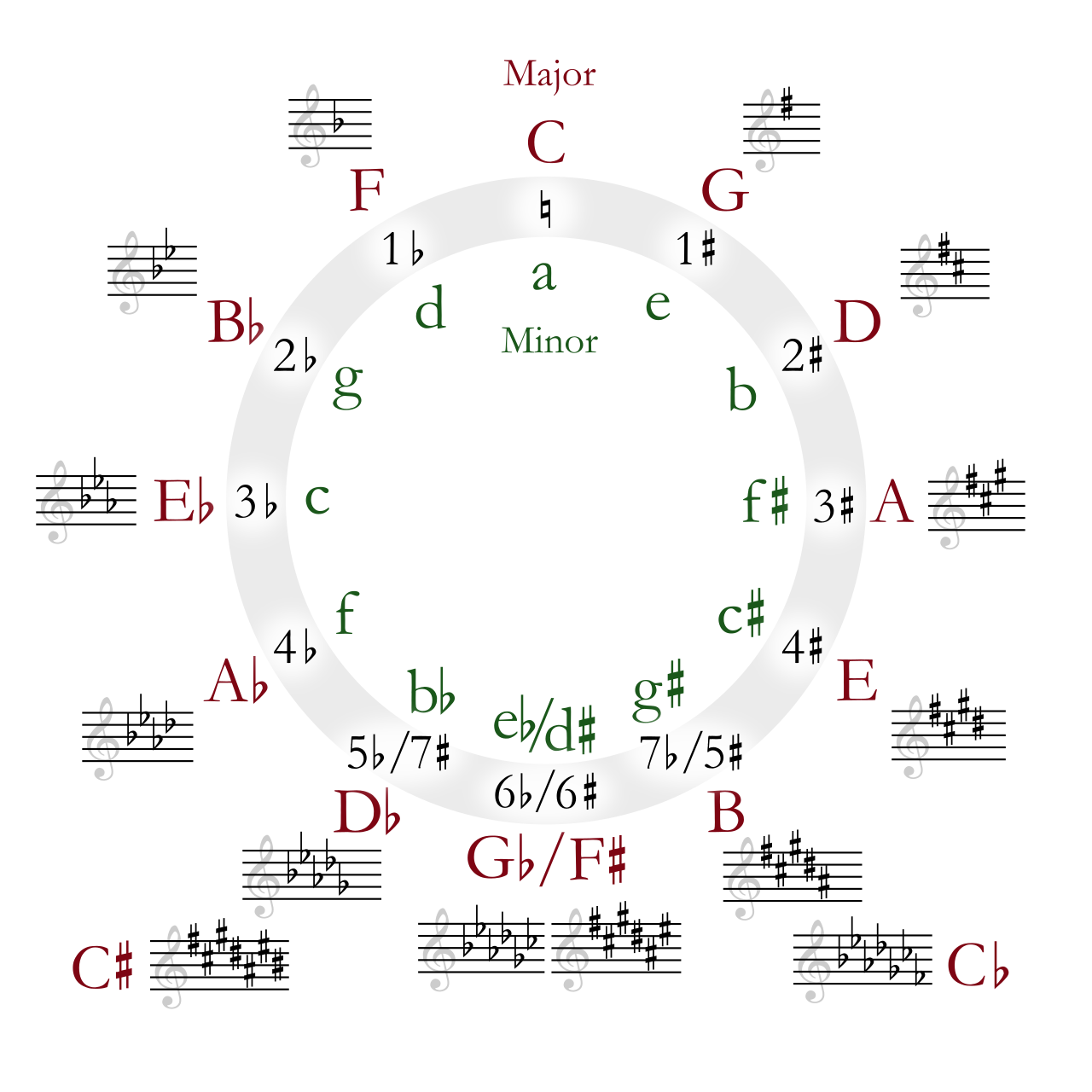
You can find the key signature next to the treble clef symbol. This tells you which key you’re playing in and whether certain notes (like F) should always be sharp or flat throughout the piece.
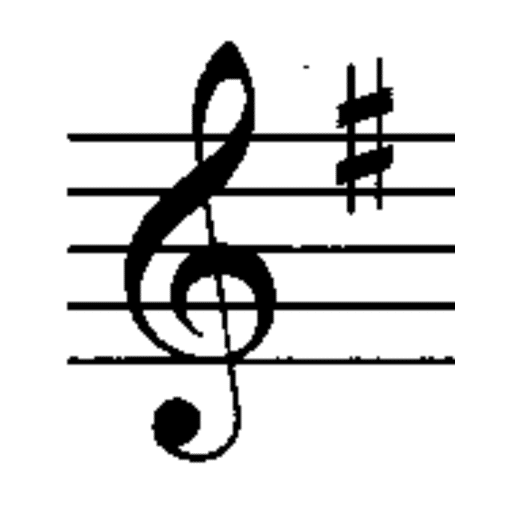
- Major or Minor: Each key signature can represent either a major or minor key. Look at the first or last note to help determine which key you’re in.
- Circle of Fifths: A handy tool for quickly identifying key signatures.
Time Signatures
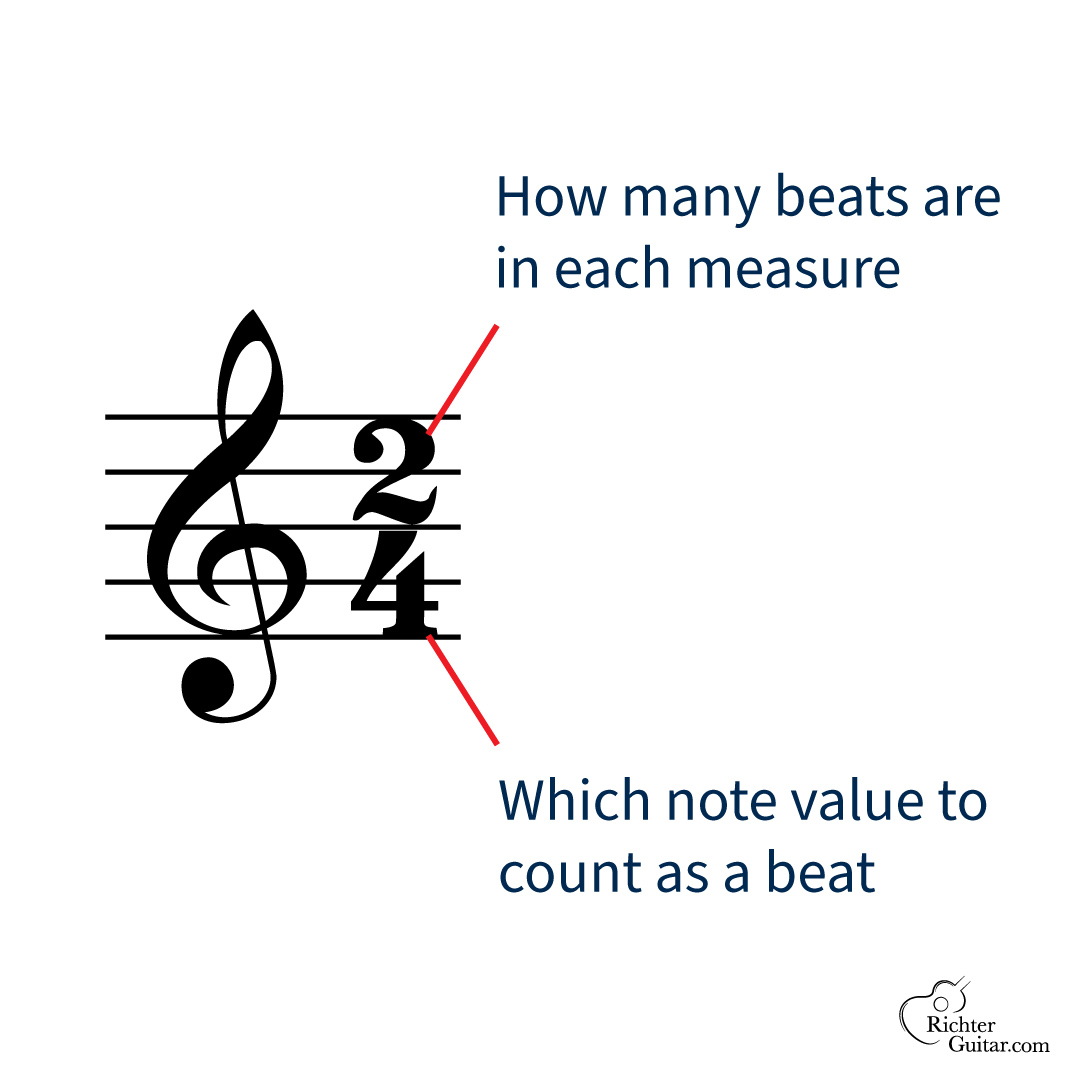
The time signature tells you how many beats are in each measure, and which note value to count as a beat. Similar to the key signature, you can find the time signature at the beginning of a piece of music on the staff after the clef.
- The top number tells you how many beats are in each measure.
- The bottom number tells you which note gets the beat. For example, in 4/4 time, there are 4 beats per measure, and a quarter note gets one beat.
For more details on Time Signatures, check out my article: Time Signatures – Definition, Examples, and How To Guide
Note Values
Here’s the most basic note values in music:
- Whole note = 4 beats
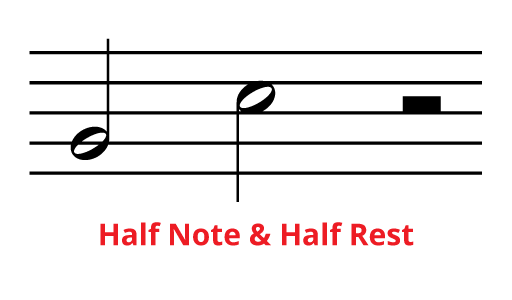
- Half note = 2 beats
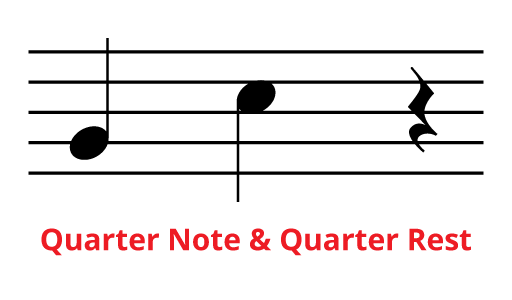
- Quarter note = 1 beat
- Eighth notes = ½ beat
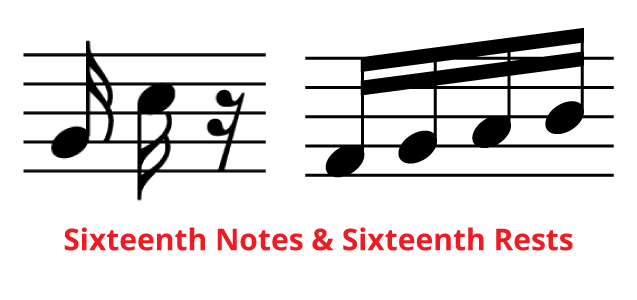
- Sixteenth notes = ¼ beat
Subdivisions
As we subdivide notes, you’ll go from quarter notes (1, 2, 3, 4) to eighth notes (1&, 2&, etc.) and even sixteenth notes (1e&a, 2e&a).
You’ll see these note values represented by different note shapes and stems:


Guitar Notation Symbols
Below are the most common notations you’ll find in classical guitar sheet music.
Left Hand Fingering Numbers
In guitar sheet music, the little numbers next to notes (0-4) indicate which left-hand finger to use, not the fret number.

Right Hand Notation
For the right hand, you may see letters like PIMA (Pulgar, Índice, Medio, Anular) which correspond to your right hand thumb and fingers.

String Numbers
Guitar is a unique instrument in that the same pitch can be played on multiple strings. Composers will use a circle with a number inside it to indicate which string the note should be played on.
For example, you’ll play the E note on string 3 with finger 1:

Barre Chords
You’ll often see a Roman numeral (like “V” for fret 5) to indicate where to place your barre for these chords.
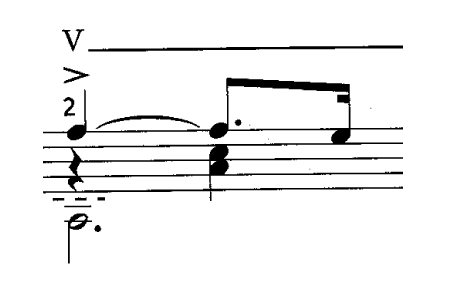
Sometimes you’ll see C5, where the C stands for “cejilla” meaning barre.
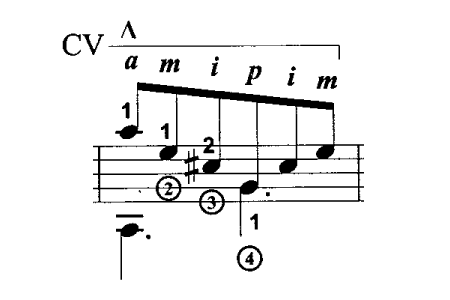
Another case you’ll come across is C with a slash through it. That indicates a half-barre, meaning your left hand index finger should just cover strings 1-3.

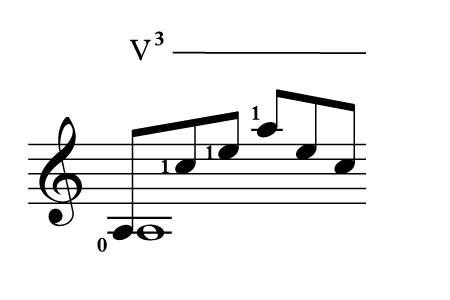
Lastly, you might also see a superscript number next to a roman number like V4. This means you’ll place a barre on fret 5, and cover strings 1-4. It’s a more precise way to indicate how many strings your left hand index finger should cover.
Dynamics and Accents
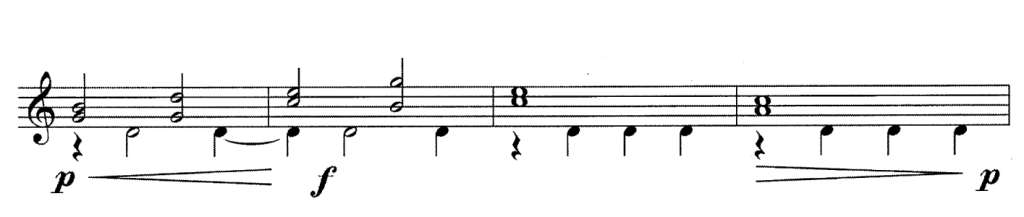
Here’s a list of the common dynamic markings you’ll find on music scores:
- ppp (pianississimo) = very very soft
- pp (pianissimo) = very soft
- p (piano) = soft
- mp (mezzo-piano) = moderately soft
- mf (mezzo-forte) = moderately loud
- f (forte) = loud
- ff (fortissimo) = very loud
- fff (fortississimo) = very very loud
You might also see crescendo (gradually louder) or decrescendo (gradually softer) markings.
Accents
A > symbol above a note means to play it with more emphasis.
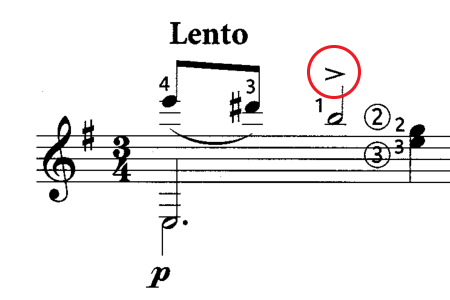
Some guitar composers, like Julio Sagreras, use the ^ symbol to indicate you should accent a note or even use the rest stroke technique:

Staccato
Represented by a dot above or below a note, this means to shorten the note’s duration for a sharper, more detached sound:
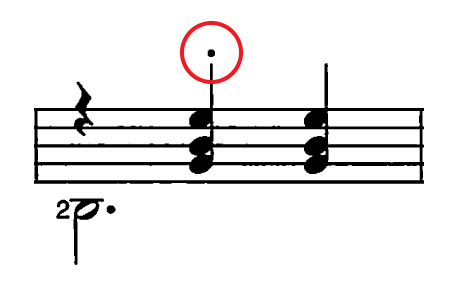
The staccato technique appears often in waltzes and bossa nova pieces. In guitar, the prep and play (planting) technique is a useful way to achieve the staccato effect.
Important Takeaways
Reading sheet music is essential for playing classical guitar, and while it may seem overwhelming at first, breaking it down into key components makes it more approachable.
Start by understanding the staff and clef, and then focus on recognizing key signatures and time signatures. Learning basic note values and how they relate to rhythm is critical, as is getting comfortable with left-hand and right-hand fingerings.
Remember, guitar music doesn’t tell you the exact fret unless it’s for a barre chord, so getting familiar with note locations on the fretboard is key. Lastly, dynamics, accents, and articulations help bring your music to life, making your playing more expressive and nuanced.
Next Steps
- Memorize the Acronyms: Use Every Good Boy Does Fine and FACE to remember the notes on the staff. Write these out or practice them daily to speed up your reading.
- Work on Note Recognition: Use flashcards or note-reading apps to quickly recognize notes and their positions on the fretboard. Check out the or for quick links to flashcard games optimized for guitar note reading!
- Practice Key Signatures: Start with the Circle of Fifths to understand how different keys work. Try playing simple pieces in different keys to get comfortable with sharps and flats. Check out these flashcard games optimized for guitar:
- Explore Rhythm: Practice clapping or tapping out rhythms for whole notes, half notes, and quarter notes. Then, move on to eighth and sixteenth notes.
- Dive Into Exercises: Begin with exercises from method books like Julio S. Sagreras or Aaron Shear to improve your sight-reading and overall fluency with sheet music.
- Dynamics Practice: Experiment with dynamics by playing a simple piece softly, then loudly, then adding accents to certain notes. Focus on making your playing more expressive.
FREE Guide PDF Download
- How to Read Guitar Sheet Music Guide
- Free Guitar Sheet Music Finder (by Composer)