If you’ve ever looked down at the guitar neck and felt like it was just a wall of frets and strings, you’re in very good company. Most of my students assume they need to memorize every single note on the fretboard, one by one, before they can find their way around.
You don’t! You need one rule: every fret on the guitar is a half step. Once that clicks, and once you know how the musical alphabet is actually spaced, you can find any note, on any string, on demand.
Below you’ll find a free printable guitar fretboard notes chart, and then the system behind it, so the chart becomes something you check your answers against rather than something you have to memorize.
Guitar Fretboard Notes Chart (Free Printable PDF)
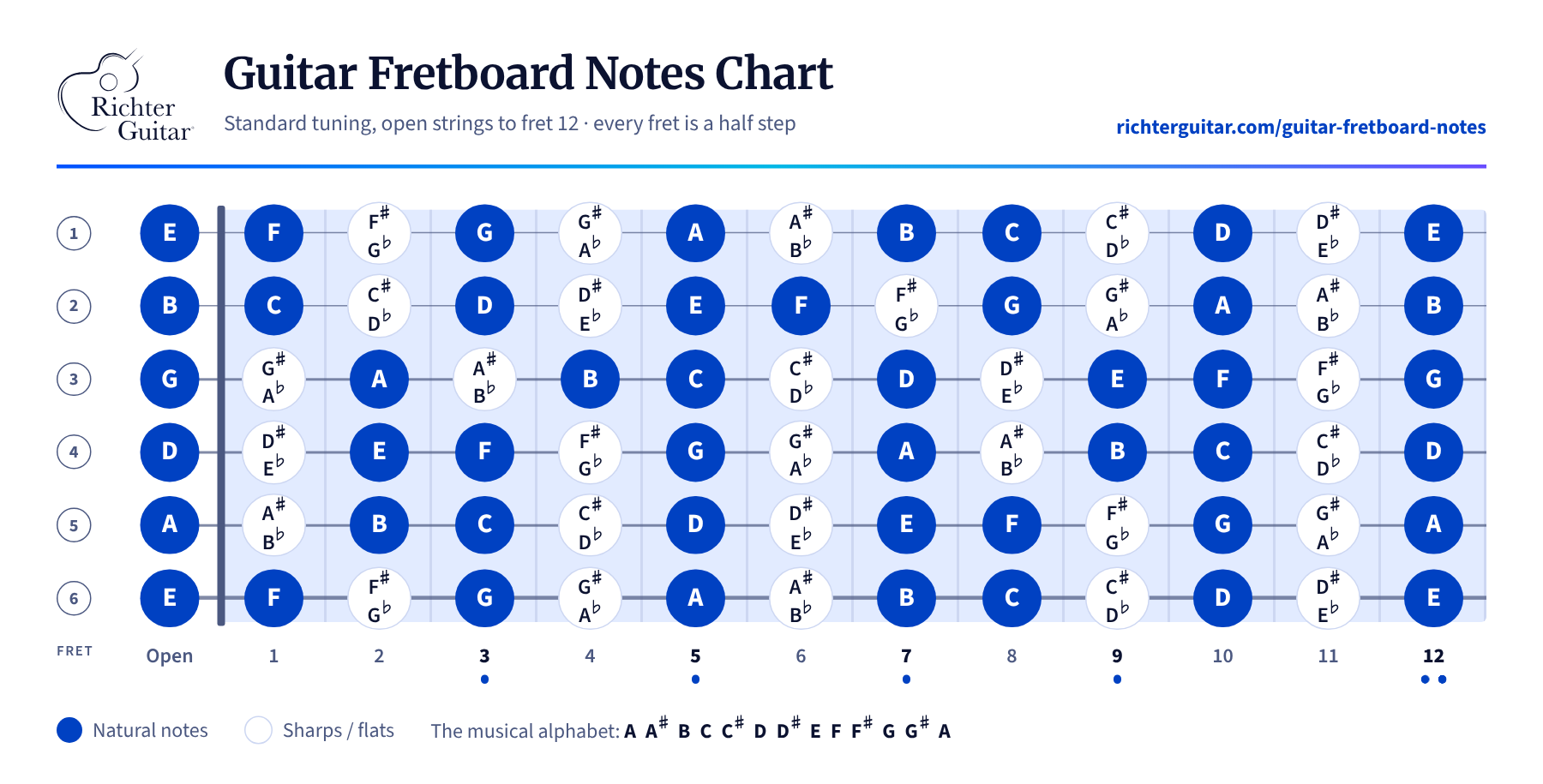
Here’s every note on the guitar in standard tuning, from the open strings up to fret 12. You’re looking down at the neck the way you do when you play: string 1, the thinnest (high E), is on top, and string 6, the thickest (low E), is on the bottom.
Guitar Fretboard Notes Chart
Standard tuning (E A D G B E) · every fret is a half step
1
E
F
F sharp/G flat
G
G sharp/A flat
A
A sharp/B flat
B
C
C sharp/D flat
D
D sharp/E flat
E
2
B
C
C sharp/D flat
D
D sharp/E flat
E
F
F sharp/G flat
G
G sharp/A flat
A
A sharp/B flat
B
3
G
G sharp/A flat
A
A sharp/B flat
B
C
C sharp/D flat
D
D sharp/E flat
E
F
F sharp/G flat
G
4
D
D sharp/E flat
E
F
F sharp/G flat
G
G sharp/A flat
A
A sharp/B flat
B
C
C sharp/D flat
D
5
A
A sharp/B flat
B
C
C sharp/D flat
D
D sharp/E flat
E
F
F sharp/G flat
G
G sharp/A flat
A
6
E
F
F sharp/G flat
G
G sharp/A flat
A
A sharp/B flat
B
C
C sharp/D flat
D
D sharp/E flat
E
FretOpen0123456789101112
Swipe the neck sideways to see frets 7 to 12 →
Guitar fretboard notes by string and fret, standard tuning
Fret
6String 6 E
5String 5 A
4String 4 D
3String 3 G
2String 2 B
1String 1 E
Open
E
A
D
G
B
E
1
F
A sharp/B flat
D sharp/E flat
G sharp/A flat
C
F
2
F sharp/G flat
B
E
A
C sharp/D flat
F sharp/G flat
3
G
C
F
A sharp/B flat
D
G
4
G sharp/A flat
C sharp/D flat
F sharp/G flat
B
D sharp/E flat
G sharp/A flat
5
A
D
G
C
E
A
6
A sharp/B flat
D sharp/E flat
G sharp/A flat
C sharp/D flat
F
A sharp/B flat
7
B
E
A
D
F sharp/G flat
B
8
C
F
A sharp/B flat
D sharp/E flat
G
C
9
C sharp/D flat
F sharp/G flat
B
E
G sharp/A flat
C sharp/D flat
10
D
G
C
F
A
D
11
D sharp/E flat
G sharp/A flat
C sharp/D flat
F sharp/G flat
A sharp/B flat
D sharp/E flat
12
E
A
D
G
B
E
Find every…
Free printable fretboard chart
Print it, keep it on your music stand, or save it to your phone. The PDF has the fretboard, the table and a link to the video lesson.
The filled notes are the natural notes, A through G. The outlined notes are the sharps and flats in between. Use the Sharps | Flats | Both switch to change how those are named.
Prefer a classic chart? Switch to Table for the same notes with one column per string.
Fret 12 has exactly the same note names as the open strings. That’s the octave, and after it the whole pattern starts over (fret 13 is the same as fret 1, and so on).
Tap any note under Find every… to see everywhere it lives on the neck.
Now let’s talk about why the chart looks the way it does. Once you understand this part, you won’t need the chart much longer!
Why the Musical Alphabet Matters on Guitar
The musical alphabet is only seven letters: A, B, C, D, E, F, G. After G it simply starts over at A.
But knowing the musical alphabet isn’t just saying A through G. There’s actually different spacing between the notes, and that spacing is the whole secret. Between two letters there’s either a half step (also called a minor second) or a whole step (a major second).
Here’s why that matters so much to guitarists:
On guitar, every fret is a half step.
So if you know the musical alphabet, not just the seven letters but the sharps and flats that go in between them, you can understand the guitar neck way, way better. I walk through all of it in this lesson:
Half Steps and Whole Steps: The Piano Trick
Ironically, I want you to think about the musical alphabet from a piano keyboard perspective first, rather than guitar. Just hang with me here. We will apply it to guitar.
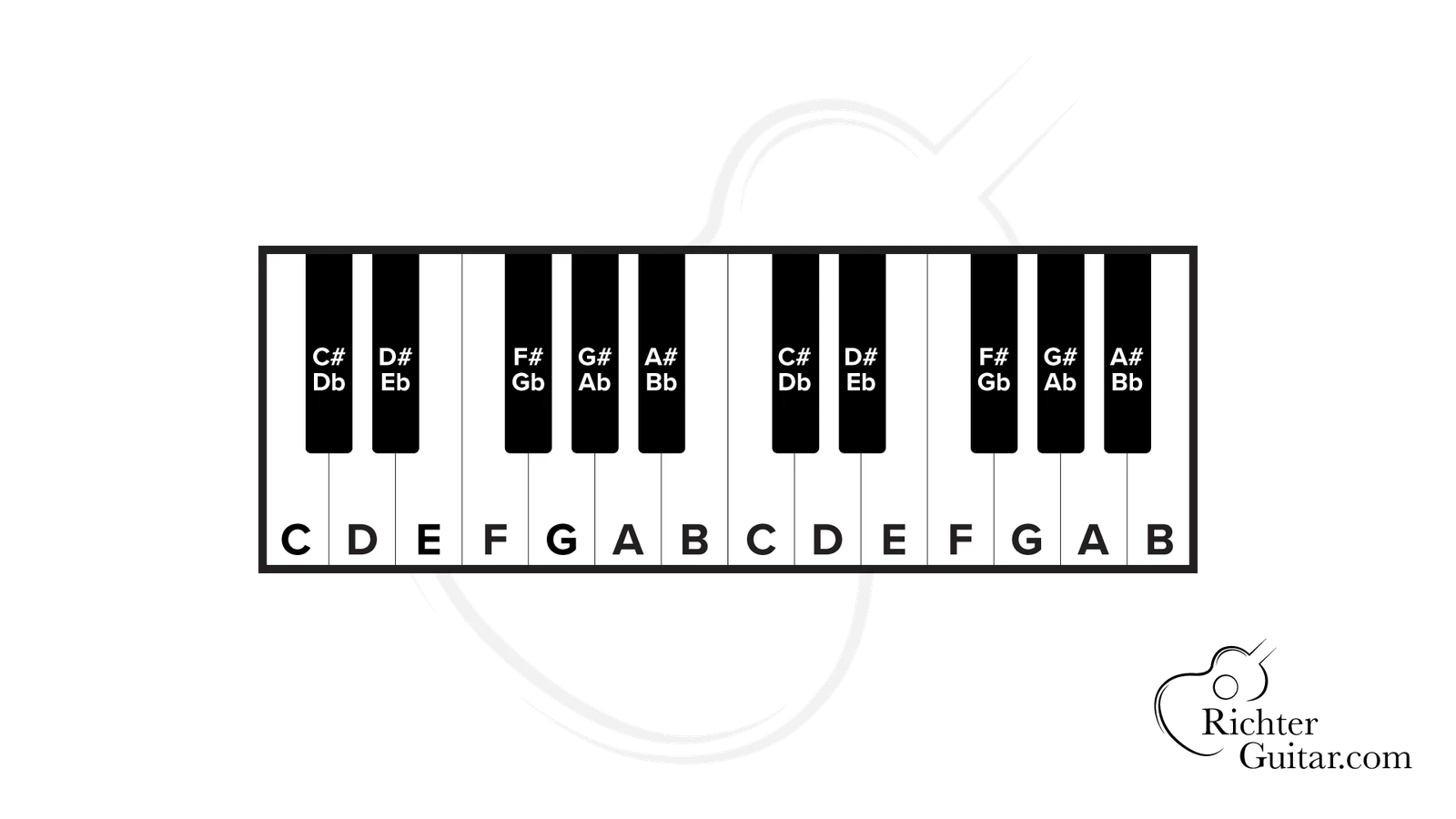
I find the piano to be the most straightforward way of visualizing the notes and the distance between them, because the black keys show you exactly where the extra notes are.
Start on the letter A. There’s a black key between A and B. So:
A to A# is a half step (one key over)
A# to B is also a half step
A to B, skipping over the black key, is a whole step
Half step, one key. Whole step, two keys. On guitar: half step, one fret. Whole step, two frets.
Sharps, Flats and Enharmonic Equivalents
That black key between A and B can be called A sharp or B flat. Yes, technically one note can have two names at once. This is called an enharmonic equivalent.
Don’t worry too much about that for now. Basically, some keys will have you playing in sharps and other keys will have you playing in flats. It’s beyond the scope of this lesson to explain all of that, and right now we just want to master the distance between the notes. So stick with sharps to begin with. We’ll get to flats further down.
The Two Exceptions: B to C and E to F
Here’s the part you really want to remember. Between every pair of letters from A to G there’s a sharp (a black key), except in two places:
B to C is a half step
E to F is a half step
There’s no black key between them on the piano. That means when you’re going up the musical alphabet, you won’t say “B sharp” or “E sharp.” You go straight from B to C, and straight from E to F.
So, to summarize, here are all twelve notes starting on A:
A, A#, B, C, C#, D, D#, E, F, F#, G, G#… and back to A.
Say that out loud a few times. It’s the most useful sentence in this whole article.
How to Find Any Note on Any String
Now let’s apply it to guitar. Remember, every single fret is a half step. So to find any note on any string:
Start with the name of the open string (E, A, D, G, B, E).
Move up one fret at a time, saying the next note of the musical alphabet at each fret.
Watch for B to C and E to F, the two spots with no sharp in between.
When you reach fret 12, you’re back to the open string’s note, one octave higher.
That’s the whole system. Let’s try it.
Example: The A String (String 5)
Start on the open A string, which is string five. Go fret by fret using finger one until you reach the octave, the next A:
5
A
A sharp/B flat
B
C
C sharp/D flat
D
D sharp/E flat
E
F
F sharp/G flat
G
G sharp/A flat
A
wholehalfwholewholehalfwholewhole
FretOpen0123456789101112
Swipe sideways to see frets 6 to 12 →
The A string (string 5), fret by fret. Every fret is a half step. Between the natural notes it’s two frets (a whole step), except B to C and E to F.
Notice fret 3: it’s C, not B sharp. And fret 8 is F, not E sharp. Those are the two exceptions doing their job.
On most classical and flamenco guitars, fret 12 is right where the body meets the neck. Play the open A and then the A at fret 12. Can you hear that it’s the same note, just higher?
Take your time with it. You don’t have to go quickly. In fact, I want you to go really slowly and be thinking about each note as you play it.
That’s the whole tactic, and it works the same way on every string. Try the low E string next: it starts with the exception right away (E, then F at fret 1).
Finding the Same Note in Different Places
The same note can be played in several places on the neck. The E in the top space of the treble staff is the open first string, but you’ll find that exact pitch on strings 2, 3 and 4 too. Tap each one:
String 1 · open
1
2
3
4
5
6
FretOpen0123456789101112131415
One note, four places. Tap an E on the fretboard: the circled number above the note tells you which string to play it on (0 means open string).
In classical guitar sheet music, that circled number tells you which string to use. The fretted versions have a warmer tone, and you can add vibrato to them. String 3, fret 9 is actually my favorite note on the guitar!
Flats, and Why Guitarists Love Sharp Keys
You can definitely think about all of this from the flat perspective too. But as guitarists, we typically play in keys that have sharps more often than flats.
That’s because flat keys, like F major or B flat major, often put home base somewhere that isn’t comfortable on guitar. Instead of ringing open strings, you end up playing barre chords for the entire piece, and that gets really exhausting. Of course you can put a capo on, but it goes to show that the guitar is kind of made to play in sharp keys a little more easily than flats.
That said, let’s do the A string one more time, this time with flats:
A, Bb, B, C, Db, D, Eb, E, F, Gb, G, Ab… and back to A.
Bb (B flat) is the exact same note as A#. It’s the same black key between A and B, so we didn’t break any rules, and B to C is still a half step. It’s almost the same as the sharps, just slightly different. Flip the switch on the chart to Flats to see the whole fretboard this way.
The “Yes, Technically…” Caveat: E Sharp and B Sharp
In a few rare keys and chords you’ll see an E sharp or a B sharp. For example, an A sharp minor chord is spelled A#, C#, E#, because chords skip every other letter. E# sounds exactly like F. (More on chord spelling in How to Build Chords.)
These are exceptions, so don’t let them confuse you. Most of the time it’s just A, A#, B, C, C#, D, D#, E, F, F#, G, G#, A.
A 5-Minute Fretboard Practice Routine
Try this right after reading:
Say it. Recite the musical alphabet with the sharps out loud: A, A#, B, C, C#, D, D#, E, F, F#, G, G#.
Play it. Pick one string (start with the A string) and go fret by fret up to the 12th, saying each note as you play it.
Spot the exceptions. Notice where B and C, and E and F, sit right next to each other with no fret between them.
Challenge. Find the note E in three different places on the fretboard. Then check your answer with the Find every… buttons on the chart.
Go slowly. Accuracy first, speed later. Once one string feels easy, pick another. A few minutes a day for a couple of weeks does more than one long cram session.
Fretboard Notes FAQ
How many notes are on the guitar fretboard?
There are only 12 different notes: the seven natural notes plus five sharps/flats. Everything on the fretboard is one of those twelve, repeated in different octaves and on different strings.
Is A sharp the same as B flat?
Yes. They’re the same pitch, played at the same fret. They’re called enharmonic equivalents, and which name you use depends on the key you’re in.
Why is there no B sharp or E sharp?
Because B to C and E to F are already half steps. There’s no black key between them on the piano, so on guitar they’re just one fret apart.
What’s the fastest way to learn the notes on the fretboard?
Don’t try to memorize the chart as a picture. Learn the musical alphabet with its two exceptions, then count up one string at a time while saying the notes out loud. Start with the low E and A strings, since those hold the root notes of most chord shapes.
Bringing It All Together
The fretboard isn’t a wall of random notes. It’s the same twelve notes in a row, over and over, one fret at a time. Every fret is a half step, two frets are a whole step, and the only places without a sharp in between are B to C and E to F.
Keep the chart handy while you practice, but use it to check yourself rather than to memorize. Before long you’ll find you’re reaching for it less and less!