
Need to learn how to play the G7 chord on guitar? Check out the video lesson, chord charts, and photos below to see how to play this dominant seventh with ease!
Video Lesson
How to play the G7 guitar chord: Chart, Photo, and Description
Below are four different ways you can play the G7 chord in open position on guitar.
Option 1: Three left hand fingers
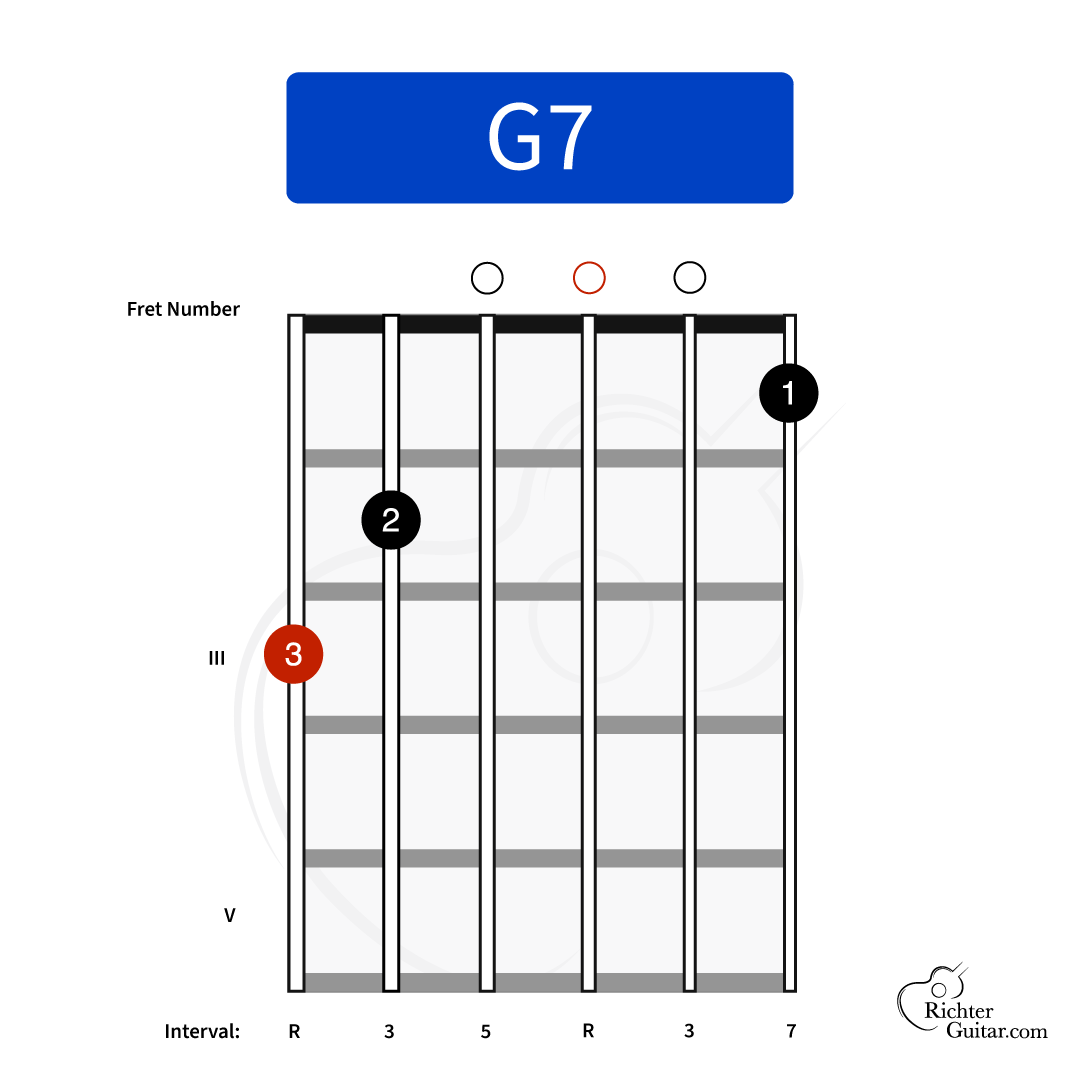

This is the most standard G7 chord shape, and is the best one for beginners to start with.
To play the chord, place your left hand fingers on the following strings and frets:
- Index (Finger 1): Fret 1, String 1 (F)
- Middle (Finger 2): Fret 2, String 5 (B)
- Ring (Finger 3): Fret 3, String 6 (G)
- You can play the following open strings:
- String 4 (open D)
- String 3 (open G)
- String 2 (open B)
Most people find this G7 chord shape much easier to play compared to the G major shape with pinky on string 1. Similar to G major, you can play all six strings on the guitar with confidence since String 6 (G) is the root of the chord!
This is a gorgeous chord that is almost always followed by the C major chord. The transition from G7 to C major is pretty easy since all of your left hand fingers are already on the correct fret! If you’re starting on G7, simply move finger 1 up to string 2, then move fingers 2 and 3 down to strings 4 and 5.
Option 2: 4 left hand fingers

This variation of the G7 chord is more advanced, and requires you to add pinky into the mix.
To play this variation:
- Index (Finger 1): Fret 1, String 1 (F)
- Middle (Finger 2): Fret 2, String 5 (B)
- Ring (Finger 3): Fret 3, String 6 (G)
- Pinky (Finger 4): Fret 3, String 2 (D)
If you’re a classical guitarist, you might recognize this shape. It was made famous by Italian composer Mauro Giuliani in his 120 Right Hand studies (Op.1)!
120 Exercises. Only 2 Chords!
The first measure is played over a C major chord, and the second chord is almost always a G7 chord. Each study varies in difficulty.
These short studies begin to get more difficult around #80.
Note that if you’re playing the Giuliani Right Hand studies, many times you can simplify this shape by omitting finger 3 on string 6 (low G).
Option 3: The bass-heavy G7
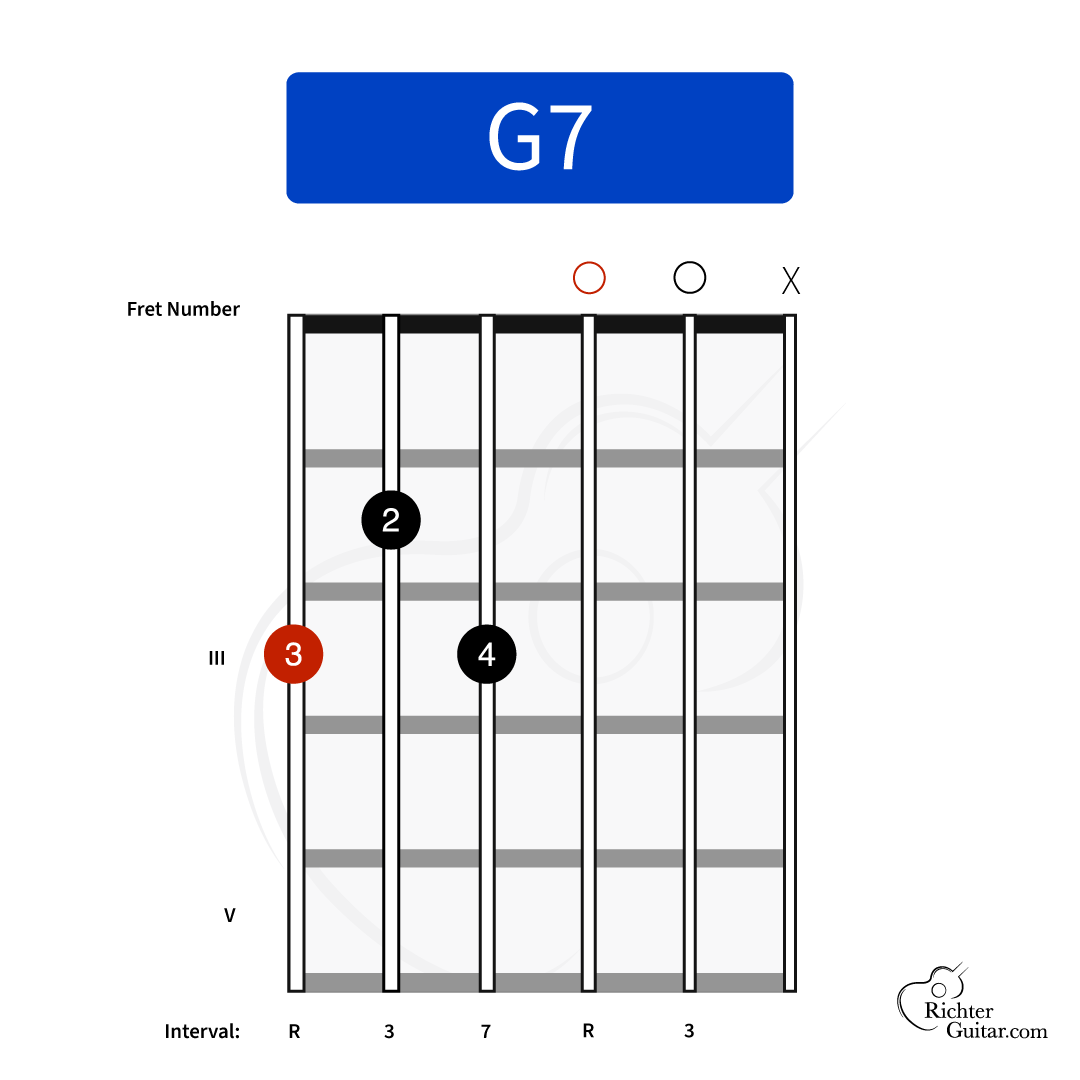
This variation moves the seventh (F) down onto the D string in the bass. This gives the chord a darker, warmer sound that works beautifully for bossa nova and Brazilian styles.
To play this variation:
- Ring (Finger 3): Fret 3, String 6 (G)
- Middle (Finger 2): Fret 2, String 5 (B)
- Pinky (Finger 4): Fret 3, String 4 (F)
You may have noticed we lost a note here — there’s no D! That’s perfectly fine. As a general rule of thumb, when you need to omit a note from a seventh chord (or a ninth chord), the fifth is the note to leave out.
You always want to keep the third, because that’s what tells your ear whether a chord is major or minor. The fifth can go without changing the character of the chord.
Option 4: The lowest G7 on the neck
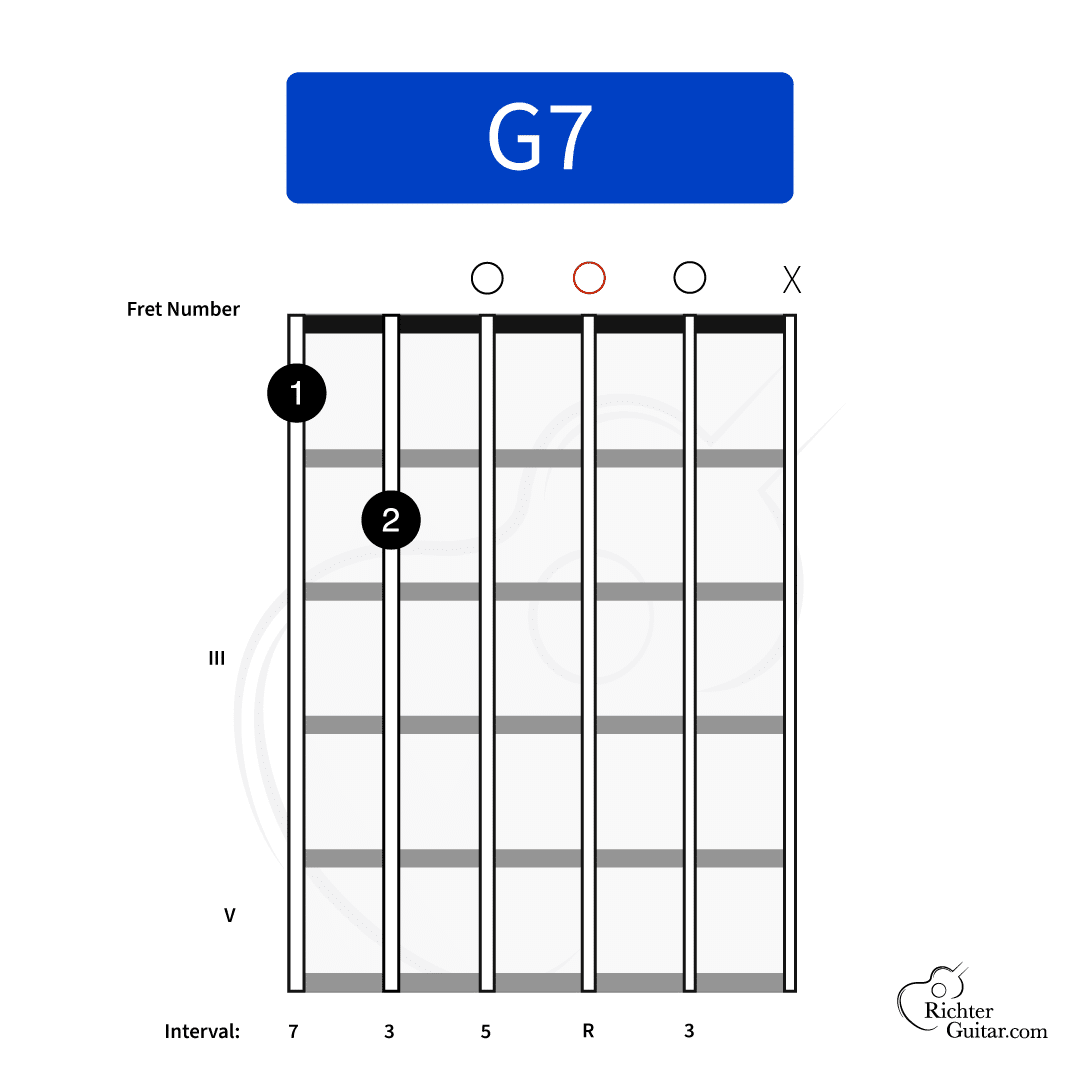
Here’s a fun one. This is the lowest seventh chord you can play on the guitar, and it only requires two left hand fingers!
To play this variation:
- Index (Finger 1): Fret 1, String 6 (F)
- Middle (Finger 2): Fret 2, String 5 (B)
- You can play the following open strings:
- String 4 (open D)
- String 3 (open G)
- String 2 (open B) — optional
We still have all four notes we need for a G7 — F, B, D, and G — just arranged in a very different order. Because the seventh (F) is sitting in the bass, this is technically called a third inversion chord, and it has a dark, heavy sound that’s quite different from the standard shape.
You won’t run into this voicing often, but it’s a great one to know. This version is also a nice reminder that a chord is defined by its notes, not by one particular shape.
What are the notes in a G7 chord?
The notes of the G7 chord are:
- G (Root)
- B (Third)
- D (Fifth)
- F (Seventh)
