
Need to learn how to play the A major chord on guitar? Check out the chord chart and photo below to see how to play the A chord with ease!
How to play the A Major guitar chord: Chart, Photo, and Description
There’s many ways to play the A major chord on guitar! Below are the shapes I recommend in order of ease and usefulness.
Option 1: Stack fingers 1,2, and 3


The shape above is the most common way to guitarists play the A major chord. I call it “the stack” since fingers 1-3 are stacked and staggered on top of one another. Overall, it’s an easy chord shape to remember!
To play the A Major chord, place your left hand fingers on the following strings and frets:
- Index (Finger 1): Fret 2, String 4 (E)
- Middle (Finger 2): Fret 2, String 3 (A)
- Ring (Finger 3): Fret 2, String 2 (C#)
- You can play the following open strings:
- String 5 (open A)
- String 1 (open high E)
- Avoid playing the String 6 (low E), which has an “X” in the box diagram above. Although this note is technically part of the A chord and won’t sound bad, more often you’ll want to play the open string 5 (A) as the lowest note. This is the root of the chord!
When you’re first learning this chord, you might find that your fingers feel a little cramped. But just remember, you don’t have to stack your fingers perfectly vertical on top of each other. On most classical guitars, fret 2 is wide. As a result, you have plenty of room for your fingers to stagger across the fret. Check out the picture above for reference!
Play each string individually with the right hand to ensure that each string is ringing clearly.
Option 2: Stack fingers 2, 1, and 3

Another popular option for playing the A major chord is to swap fingers 1 and 2.
To play this variation:
- Index (Finger 1): Fret 2, String 3 (A)
- Middle (Finger 2): Fret 2, String 4 (E)
- Ring (Finger 3): Fret 2, String 2 (C#)
At first this shape can feel a little strange. After all, isn’t “the stack” easy enough to play? What’s the advantage of playing the chord like this?
Well, the reason this shape is helpful is because the A major chord transitions to or from E major or D major very often.
If you’re transitioning from A major to E major, then finger 1 can act as a guide finger and slide over from fret 2 (A) to fret 1 (G#).
If you’re transitioning to or from A major to D major, then finger 1 can act as an anchor finger and stay down on fret 2, string 3 (A).
Option 3: Stack fingers 2, 3, and 4
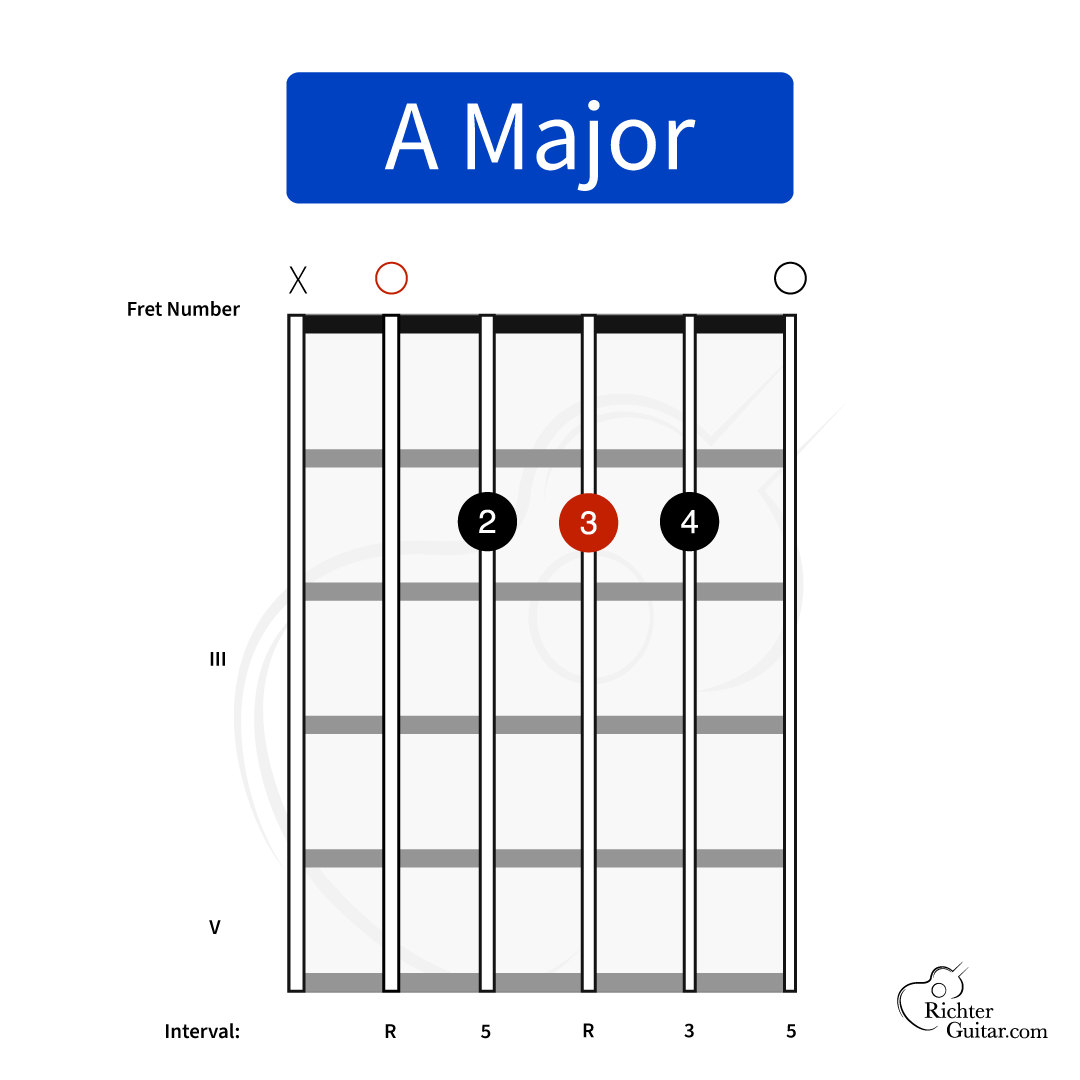
This chord shape option is less common than the others. However, it’s still useful to learn because this is the formation your left hand fingers will be in when you’re playing barre chord sequences that use this major chord shape!
To play this variation:
- Middle (Finger 2): Fret 2, String 4 (E)
- Ring (Finger 3): Fret 2, String 3 (A)
- Pinky (Finger 4): Fret 2, String 2 (C#)
If you’re playing a piece that has barre chords like B flat major that transition to or from the A major shape, like the Bulería, then this is a great way to play it!
Option 3: Half barre covering strings 4, 3, and 2 only (Advanced)

Are you an advanced guitarist hoping to work on your barre skills? If so then try out this awesome variation of the A major chord where index (finger 1) covers strings 4, 3, and 2 only! This is a common shape in the flamenco guitar world, as it frees up your other fingers to play additional notes and embellishments.
To practice this shape, let your index finger cover strings 4-1. Then, try to flatten the top joint of the index finger so that it only covers strings 4-2, and the bottom of the finger releases from string 1.
Keep the hand and fingers relaxed, and don’t overdo it. If you feel any pain or discomfort, please take a break or try a different variation.
This shape takes time to patience, but once you get comfortable with it then a lot more possibilities open up for you!
What are the notes in an A Major chord?
The notes in an A chord are:
- A (Root)
- C# (Third)
- E (Fifth)
